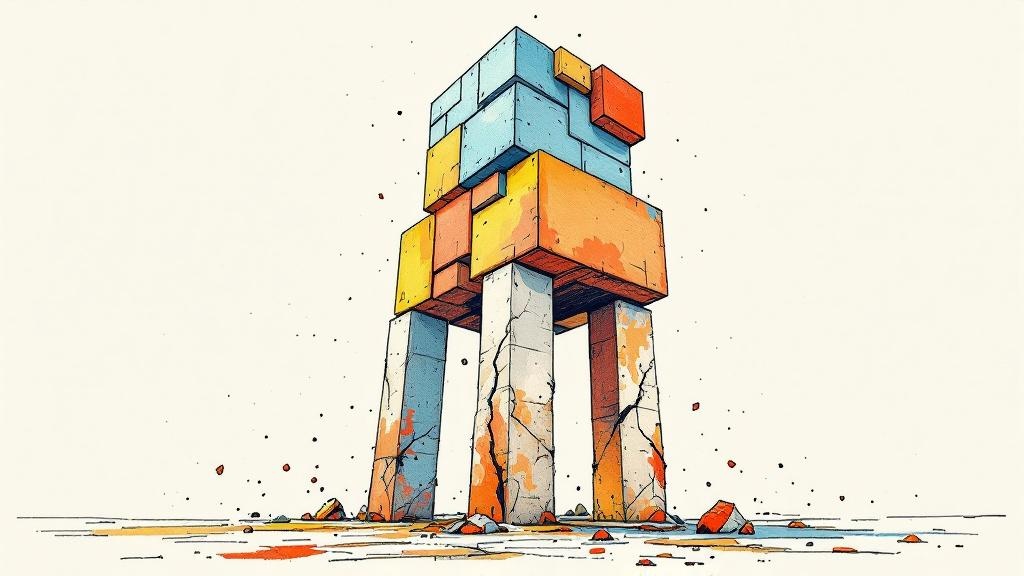
On March 20, a hand-drawn sketch titled “Long Range Strategic Business Plan” went viral across X, LinkedIn, and Instagram, widely attributed to Elon Musk, though no original post appears on his account. A tower of tech buzzwords stacked like a house of cards, with one thin pillar at the bottom holding everything up: the Strait of Hormuz.
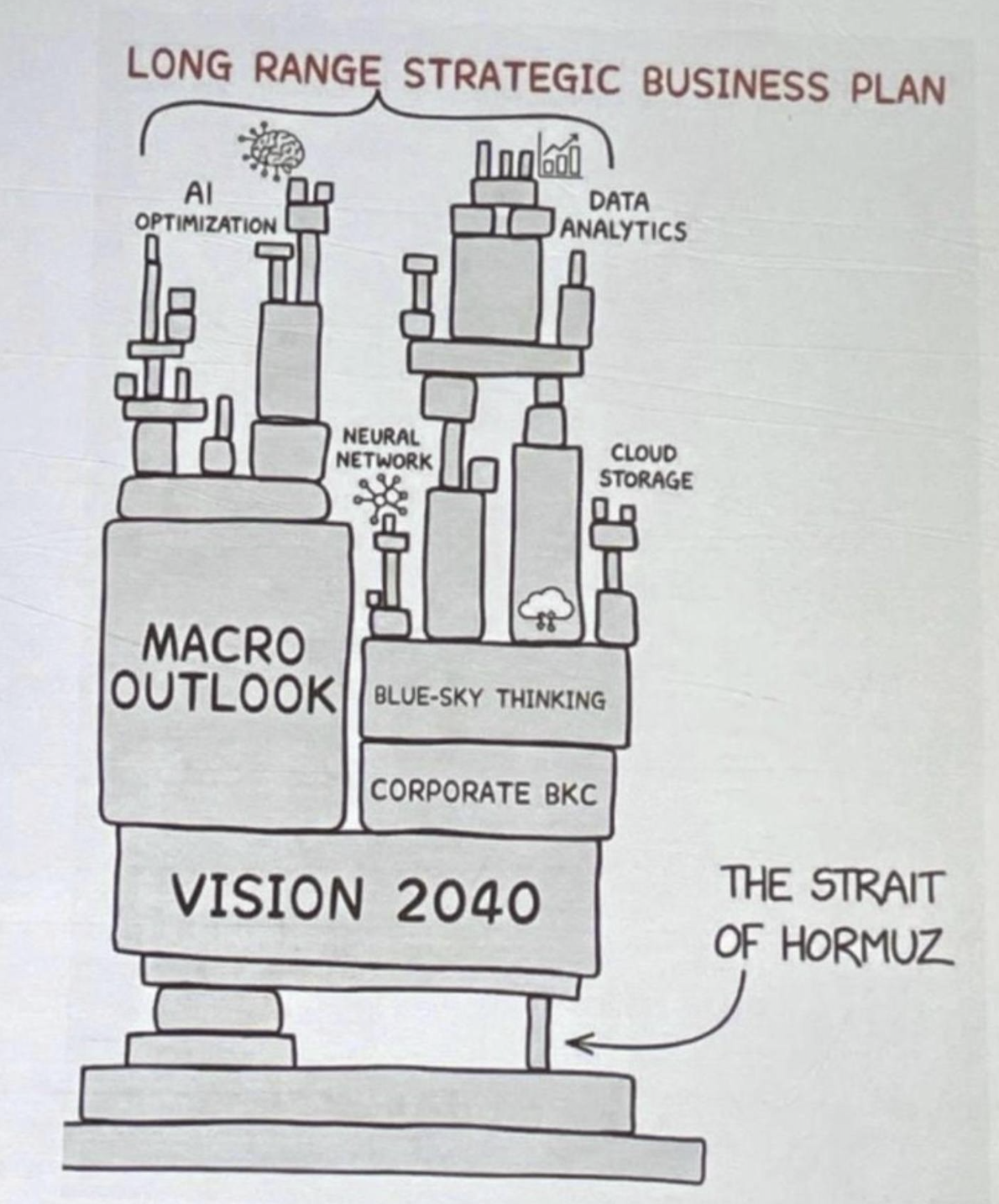
The attribution matters less than the accuracy. The sketch captures a structural truth that most strategy decks avoid: AI runs on physical infrastructure, and that infrastructure has a geography.
Four dependencies, three in crisis
$1.5 trillion in AI capital commitments assume four physical things will keep working. Energy will flow. Chips will be manufactured. Submarine cables will carry data. Raw materials will reach factories.
In March 2026, three of the four are under simultaneous stress.
Energy. Iran closed the Strait of Hormuz on March 3, following a joint US-Israeli strike. Tanker traffic collapsed from 100 vessels per day to 21 since hostilities began. Brent crude hit $126. The IEA called it the largest energy disruption in recorded history.
Energy accounts for up to 60% of data center operating costs. A single AI server draws 40 to 100 kilowatts, ten times a traditional server. Every ChatGPT query requires roughly a thousand times the electricity of a standard Google search. The Federal Reserve Bank of Dallas calculated that a single-quarter Hormuz closure shaves 2.9 percentage points off global GDP. $64 billion in US data center projects are already blocked or delayed.
Infrastructure. On March 1, three days before the strait closed, Iranian drones struck three AWS data centers in the Gulf: two in the UAE, one in Bahrain. It was the first military attack on a hyperscale cloud provider in history. Two of three AWS availability zones in the UAE went down. Banks, payment apps, and enterprise systems went dark.
Fortune reported that the US military uses AWS infrastructure, including Anthropic’s Claude model, for intelligence assessments and combat simulations. Iran’s Revolutionary Guard claimed the data centers served American military and intelligence networks.
Meanwhile, 17 submarine cables crossing the Red Sea carry 18% of global data traffic. For the first time, both the Red Sea and the Strait of Hormuz are closed simultaneously to commercial shipping. Meta froze its submarine cable project in the Persian Gulf. Companies discovered that standard insurance policies do not cover war damage.
The “cloud” has a physical address, a blast radius, and insurance terms that don’t cover war.
Semiconductors. TSMC produces 90% of the world’s advanced chips on one island. A single chip crosses 70 international borders across 100 days and 1,000 production steps. Bloomberg Economics estimates a conflict over Taiwan would cost the global economy roughly $10 trillion, more than the economic damage from COVID-19.
This is not a theoretical scenario. Demand for advanced AI chips currently exceeds TSMC’s capacity by a factor of three. Google cut its 2026 TPU chip production target from four million to three million units. Consumer electronics prices have already risen 20% to 30%. TSMC is investing $40 billion in Arizona fabrication plants, but advanced facilities take 3 to 4 years to build and 2-nanometer production is not expected before 2030.
Raw materials. China refines approximately 91% of global rare earth elements and produces 94% of permanent magnets, up from 50% two decades ago. An IEA report from 2025 found that in 19 of 20 strategic minerals, China is the leading refiner with an average market share of 70%.
In October 2025, China expanded export restrictions to 12 rare earth elements and activated a version of the FDPR rule, the same mechanism the US used to restrict chip exports to China, but in reverse. Any product containing Chinese-sourced rare earths now requires end-use reporting, even if manufactured outside China. The US Geological Survey estimates a full ban on gallium and germanium would cost the American economy $3.4 to $9 billion.
The nuclear counter-narrative
Tech companies are not blind to the energy problem. Over the past year, nuclear deals totaling more than 10 gigawatts have been signed: Microsoft is restarting Three Mile Island, Amazon committed to 960 megawatts, Google signed a first-of-its-kind deal for small modular reactors, and Meta and Oracle are exploring similar plans.
But nuclear solves only the energy bottleneck. It does not manufacture chips, lay submarine cables, or refine minerals. The Hormuz crisis is happening now. The solutions appearing in strategy presentations will not mature for five to ten years.
The $14 billion in physical AI funding that poured in during early 2026 assumed these supply chains would hold. The boards approving those AI budgets rarely asked what happens when the physical layer breaks.
Strategy decks are full of “Vision 2040.” The map still decides which visions survive.