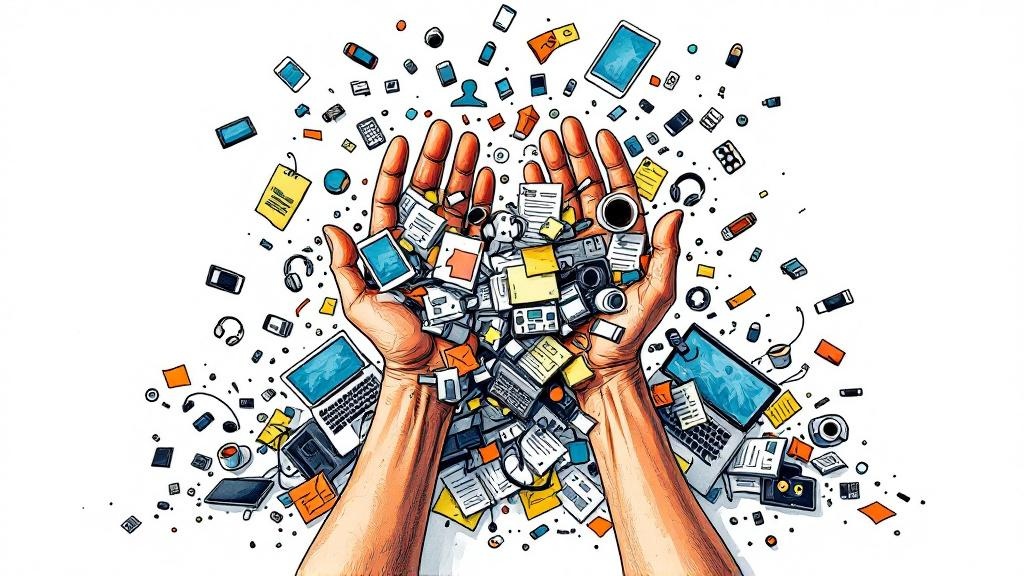
The average organization now runs 7 AI tools. Two years ago, it was 2. The adoption happened fast. The question of whether people can absorb it all came later.
BCG and the University of California, Riverside studied 1,488 workers across U.S. companies to find out what happens when AI tool adoption outruns human capacity. The answer has a specific shape: at 1-2 tools used simultaneously, workers reported real productivity gains. At 3, diminishing returns. At 4 or more, self-reported productivity collapsed.
The people breaking aren’t who you’d expect
BCG calls it “AI brain fry” - mental fatigue from managing too many AI systems at once. 14% of workers in their study reported it. The instinct is to assume these are the disengaged employees, the ones who were already struggling. The data says the opposite. The workers reporting the highest levels of AI-induced fatigue were the high performers. The people who adopted the most tools, learned them fastest, and integrated them deepest were the first to hit the wall.
The costs are measurable. Workers experiencing brain fry reported 39% more major errors, 33% higher decision fatigue, and 34% said they were planning to quit. Marketing departments were hit hardest at 26%. Legal was lowest at 6%. The pattern tracked with oversight burden: the more time spent checking, verifying, and managing AI outputs across multiple tools, the worse the fatigue.
The macro picture confirms it
Goldman Sachs put it plainly in March: “No meaningful relationship between productivity and AI adoption at the economy-wide level.” This isn’t Goldman being skeptical about AI. It’s Goldman reading the data and noting that the expected productivity wave hasn’t materialized at scale.
ActivTrak’s study of 10,584 workers told the same story from the operational side. Time spent on daily tasks increased between 27% and 346% since AI adoption. Email time alone doubled. The tools designed to save time were creating new categories of work: prompt writing, output verification, cross-tool coordination, context switching between interfaces.
Where the tipping point lives in your organization
The BCG research suggests the line is around 3 simultaneous tools. But “simultaneous” is the key word. This isn’t about how many AI tools your company has purchased. It’s about how many any individual worker is expected to use in a single workflow.
A marketing manager who drafts copy in one tool, generates images in another, analyzes performance in a third, and schedules distribution through a fourth has crossed the line. Each tool individually might save time. Together, the cognitive overhead of moving between them, remembering each interface’s logic, verifying each output, and maintaining context across systems creates more work than it eliminates.
The BCG study found one mitigating factor: organizations where managers actively helped employees prioritize and limit their AI tool use saw 15% lower fatigue rates. The fix isn’t fewer tools at the company level. It’s fewer tools per person, per task.
The question most organizations skip
Most companies track AI adoption by counting tools deployed and employees with access. Those metrics measure spread. They don’t measure load. And the difference between spread and load is where brain fry lives.
Before your next quarterly review, try one exercise: pick your three highest-performing teams and count how many AI tools each person on those teams uses in a typical day. Not how many they have access to. How many they actually open, switch between, and manage outputs from. If the number is above 3, the BCG research suggests you may already be past the tipping point, and your best people are absorbing the cost.
Related: The Case for Using AI Less explores the other side of this problem: when AI dependency erodes the judgment your team needs most.